
Central & East Asia
Xiongnu Empire
At a glance
- The first great steppe empire of eastern Eurasia, the Xiongnu confederation dominated Mongolia from about 209 BCE.
- For decades it forced Han China to pay tribute in silk and princesses; its decimal army and court became the model for later steppe empires.
- Han campaigns, natural disasters and rival chanyu split it in 48 CE; the Northern Xiongnu vanished as a power around 91 CE.
Rise & Fall
- 209 BCEModu seizes power from his father Touman and unites the Xiongnu
- 200 BCEModu surrounds Han Emperor Gaozu for seven days at the Battle of Baideng
- 198 BCEThe Han accept the heqin treaty of gifts and royal brides in exchange for peace
- 133 BCEA failed Han ambush at Mayi ends the policy of appeasement
- 119 BCEWei Qing and Huo Qubing defeat the Xiongnu at the Battle of Mobei
- 51 BCEChanyu Huhanye travels to Chang'an and acknowledges Han overlordship
- 48The confederation splits into Southern and Northern Xiongnu
- 89The Northern Xiongnu suffer a crushing defeat by Han forces and their allies
Foundation

The Xiongnu Empire was the first great steppe empire of eastern Eurasia, a confederation of nomadic and semi-nomadic peoples that dominated the eastern steppe from about 209 BCE until the late first century CE and drew Han China into a relationship of appeasement, negotiation and eventually prolonged warfare that shaped the development of both. It was unified and organised by Modu Chanyu (r. 209–174 BCE), who seized power from his father Touman in a coup described by the historian Sima Qian: Modu trained his followers to shoot their whistling arrows wherever he aimed, executing those who hesitated when he shot at his own favourite horse and then his favourite wife, until they unhesitatingly loosed their arrows at his father. Modu's campaigns united the peoples of Mongolia and Inner Asia, destroyed and absorbed the Donghu confederacy to the east, defeated the Yuezhi of the Gansu region, and brought peoples further west under Xiongnu suzerainty. His confrontation with the newly founded Han Dynasty culminated in 200 BCE in the Battle of Baideng, near Pingcheng, where Emperor Gaozu was surrounded for seven days by a Xiongnu army that Chinese sources number at 400,000 horsemen, escaping only after his envoys bribed the chanyu's consort. The humiliation led the Han in 198 BCE to accept the heqin ('peace through kinship') arrangement: annual gifts of silk, grain, wine and other goods, and the dispatch of a Han princess, usually an imperial kinswoman, as a bride for the chanyu, in exchange for peace. This inversion of the Sinocentric world order shaped Chinese strategic thinking for centuries and opened a Han-Xiongnu relationship that produced some of the most consequential military, diplomatic and cultural exchanges of the ancient world.
Socioeconomy

The Xiongnu economy was built on mobile pastoralism, the herding of horses, cattle, sheep, goats and camels across the seasonal pastures of the Mongolian steppe, supplemented by hunting, some farming and metalworking in settled enclaves, raiding, tribute from neighbouring peoples and the control of long-distance trade. The chanyu's court received regular gifts from Han China in silk, grain, wine and manufactured goods under the heqin treaties; drew tribute from subject peoples, including the oasis states of the Tarim Basin, over which a Xiongnu official was posted to collect levies; and profited from frontier markets and the traffic passing through Xiongnu-controlled territory. This diversified revenue supported a political apparatus far more elaborate than the mobile way of life of its constituent population might suggest. Chinese silk was especially important: it served as a medium of reward distributed by the chanyu to subordinate leaders, a luxury displaying his access to Chinese wealth, and a trade commodity that moved westward through Central Asian intermediaries towards Parthia and eventually the Roman world. Archaeological finds from elite Xiongnu kurgan tombs at sites such as Noin-Ula (Noyon Uul) and Gol Mod, including Han lacquerware and bronze mirrors, textiles from Central Asia and the Hellenistic world, and Roman glass, demonstrate the remarkable geographic reach of the exchange networks that converged on the Xiongnu elite. The system was redistributive: the chanyu and subordinate leaders gathered surpluses from raids and tribute and redistributed them to secure the loyalty of their followers, creating dependencies that bound the confederation together but left it vulnerable whenever the flow of resources was disrupted.
Military
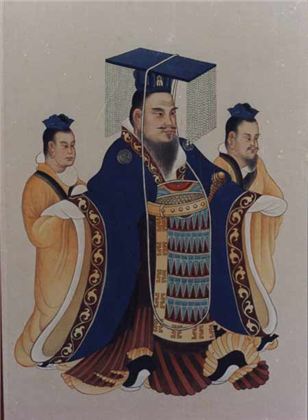
The Xiongnu military was built around the mounted archer, the fundamental unit of steppe warfare, whose combination of mobility, firepower and tactical flexibility gave nomadic forces decisive advantages over sedentary infantry armies in open terrain. Xiongnu horsemen, trained from childhood, could shoot in any direction, including backwards at full gallop, could cover in hours distances that infantry armies needed days to cross, and could simply break off any engagement in which conditions were unfavourable, a practice Chinese observers regarded as shameless but which was highly effective. This was not merely a matter of individual horsemanship but of systematic organisation: Sima Qian describes a hierarchy of commanders of ten, a hundred, a thousand and ten thousand men, an arrangement that became the template for later steppe military organisation, including eventually the Mongol system. The mobility this provided made conventional Han frontier defence extremely difficult, for Chinese armies could march to the frontier, but the Xiongnu simply evaded contact and struck elsewhere, making it nearly impossible to protect the whole length of the northern border. Emperor Wu of Han broke with appeasement after the failed ambush at Mayi in 133 BCE and built up large cavalry forces capable of deep campaigns into the steppe. The great expeditions of the generals Wei Qing and Huo Qubing between 129 and 119 BCE, which seized the Hexi Corridor in 121 BCE and culminated in the Battle of Mobei north of the Gobi in 119 BCE, were the most successful Han counter-offensives and marked the beginning of the long Xiongnu decline. The confederation's ultimate weakness was its dependence on the chanyu's ability to keep resources flowing: when Han pressure disrupted tribute and internal succession struggles produced rival leaders, its military cohesion fragmented.
Governance & Law
For a nomadic confederation, the Xiongnu state was a sophisticated political organisation, combining centralised royal authority vested in the chanyu with a layered hierarchy of subordinate commanders whose independent military power was both the empire's strength and the most persistent threat to central authority. The chanyu, whose full title Chinese sources render as chengli gutu chanyu, glossed as 'son of heaven, vast one', held supreme authority over the confederation: he conducted diplomacy, allocated pastures, distributed captured wealth and commanded the combined army in major campaigns. Beneath him the confederation was divided into left (eastern) and right (western) wings, each headed by a Wise King (tuqi wang) who was normally a close kinsman of the chanyu, the Wise King of the Left usually being the heir apparent, with some twenty-four great commanders and lesser officers ranked below them in the decimal hierarchy. Leading aristocratic clans, such as the Huyan, Lan and Xubu, intermarried with the ruling Luandi lineage and held hereditary offices. Regular assemblies, including a spring gathering at the chanyu's court, a summer gathering at Longcheng for sacrifices to ancestors, heaven and earth, and an autumn assembly at which people and livestock were counted, provided periodic occasions to reaffirm authority and redistribute wealth. Law was customary and, according to Chinese sources, brief and severe: drawing a blade more than a foot from its sheath in a quarrel was punishable by death, theft by confiscation of the offender's household, and lesser offences by beating. The heqin relationship with Han China was a sophisticated diplomatic and commercial arrangement that successive chanyu used to secure access to Chinese goods without the risks of all-out war against Han power at its height.
Global & Regional Impact

The Xiongnu Empire's historical impact extended far beyond its long confrontation with Han China, operating through the chain of migrations, political upheavals and cultural exchanges that its expansion and eventual collapse set in motion across Eurasia. The Yuezhi, defeated by Modu around 176 BCE and finally driven from the Gansu region under his son Laoshang, migrated westward, and this migration of the Yuezhi set off a cascade of population movements that ended with their settlement in Bactria and the later rise of the Kushan Empire, one of the great crossroads states of Eurasian history. The Han search for allies against the Xiongnu also sent Zhang Qian on his celebrated mission to the Yuezhi in 139 BCE, opening Chinese knowledge of Central Asia and helping to establish the routes later known as the Silk Road. After the confederation split in 48 CE, the Southern Xiongnu settled within the Chinese frontier, contributing to the transformation of northern China that culminated in the Sixteen Kingdoms period of the fourth and fifth centuries, when Liu Yuan, a Xiongnu noble, founded the Han Zhao state in 304, and his successors sacked Luoyang in 311. The Huns who invaded Europe in the late fourth and fifth centuries may have been connected with the Xiongnu, though the link remains debated; their pressure helped to drive Germanic peoples across the Rhine and Danube frontiers and contributed to the crisis of the Western Roman Empire. The Xiongnu political and military model, with its decimal organisation, mounted archery, left and right wings and charismatic ruling lineage, became a template on which later Inner Asian empires built, including the Xianbei, Rouran, Göktürks, Uyghurs and ultimately the Mongols, making the Xiongnu a foundational institution of the steppe imperial tradition.
Decline & Fall

The Xiongnu Empire's decline was a prolonged process spanning more than two centuries, driven by sustained Han military pressure, severe ecological disasters and recurrent succession conflicts that repeatedly fractured the confederation. The great campaigns of Emperor Wu (r. 141–87 BCE), conducted by Wei Qing and Huo Qubing with new Chinese cavalry forces, drove the Xiongnu north of the Gobi and seized the strategically vital Hexi Corridor linking China to Central Asia, depriving the chanyu of valuable pastures and access to the western trade routes and the oasis states. Han armies and their allies continued to contest control of the Tarim Basin, and heavy snows (dzud), droughts and livestock epidemics recorded in the first century BCE killed great numbers of animals and people, weakening the base of Xiongnu power. A succession crisis around 57 BCE, the Xiongnu civil war, produced as many as five rival chanyu, and in 51 BCE the chanyu Huhanye travelled in person to the Han court at Chang'an, acknowledging Han overlordship in return for protection and gifts, while his brother and rival Zhizhi withdrew westward, where he was killed by a Han expedition in 36 BCE. The final Split of the Xiongnu came in 48 CE, when the Southern Xiongnu accepted Han client status and settled along the frontier while the Northern Xiongnu remained beyond the Gobi. The Northern Xiongnu were repeatedly defeated by Han forces and by their former subjects the Xianbei, suffering a crushing defeat in 89 CE, and around 91 CE they disappeared from the Chinese record as a power on the Mongolian steppe. The Southern Xiongnu became progressively sinified, and their descendants played major roles in the upheavals of the Three Kingdoms and Jin periods.
The Xiongnu Empire's most consequential legacy was the creation of a steppe imperial template, with its decimal military organisation, chanyu court and negotiated relationship with China, that shaped Inner Asian political organisation for some fifteen centuries, while the migrations its rise and fall set in motion reshaped the peoples of China, Central Asia and, perhaps indirectly, the late Roman world.
References
- Barfield, T.J. (1989) The Perilous Frontier: Nomadic Empires and China, 221 BC to AD 1757. Oxford: Blackwell.
- Brosseder, U. and Miller, B.K. (eds.) (2011) Xiongnu Archaeology: Multidisciplinary Perspectives of the First Steppe Empire in Inner Asia. Bonn: Rheinische Friedrich-Wilhelms-Universität.
- Cosmo, N. di (1999) 'The Hsiung-nu', in J. Harmatta (ed.) History of Civilizations of Central Asia. Vol. 2. Paris: UNESCO, pp. 243–269.
- Di Cosmo, N. (2002) Ancient China and Its Enemies: The Rise of Nomadic Power in East Asian History. Cambridge: Cambridge University Press.
- Sima Qian (1993) Records of the Grand Historian: Han Dynasty II. Translated by B. Watson. Revised edn. New York: Columbia University Press.
- Yü, Y.S. (1990) 'The Hsiung-nu', in D. Sinor (ed.) The Cambridge History of Early Inner Asia. Cambridge: Cambridge University Press, pp. 118–149.
Connections
Open the full connections map →


